I Don't Want a Smart Home. I Want an Observable One.
When people talk about a smart home, the conversation usually starts with automation.
Lights that switch themselves on.
Shutters that follow the sun.
Air conditioning controlled from a phone.
Scenes, schedules, voice assistants, sensors.
I want some of that too.
But it is not the part that interests me most.
What I really want is a house that can tell me what is happening.
I don’t just want a smart home.
I want an observable one.
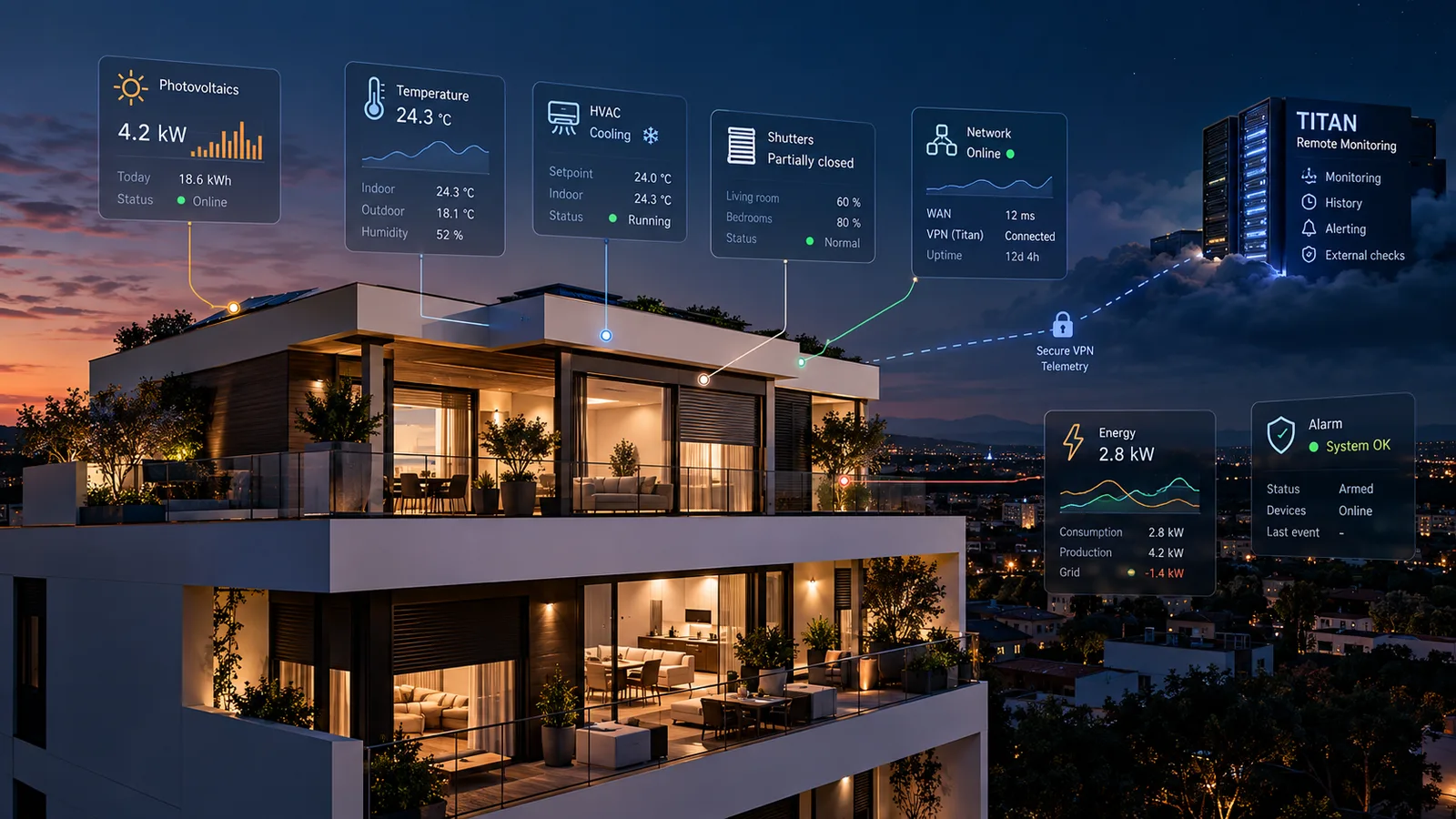
Automation and observability are not the same thing
Automation is about making something happen.
Observability is about understanding what happened.
The distinction is subtle, but important.
Automation asks:
Can I close the shutters automatically?
Observability asks:
Are they closed?
When did they close?
Did the command actually succeed?
What was the temperature before and after?
Automation asks:
Can I change the air conditioning remotely?
Observability asks:
Is it running?
For how long?
Is the room actually getting cooler?
Is its behavior different from normal?
The two ideas complement each other.
I am not interested in removing automation.
I just do not want automation without visibility.
The house is becoming infrastructure
My new home is still being built, so most of this architecture exists today as an intention rather than an implementation.
But some of the components are already clear.
There will be a Vimar control system, temperature management, air conditioning, motorized shutters and photovoltaic panels.
Being on the top floor also makes the thermal behavior of the apartment particularly interesting to me.
An alarm system will probably come later.
And underneath all of this there will obviously be the network.
Taken individually, these are just devices and systems.
Together, they start looking suspiciously like infrastructure.
network
temperature
HVAC
shutters
solar
power
devices
alerts
history
And once I start looking at them as infrastructure, my questions change.
I stop asking only:
What can I control?
and start asking:
What can I observe?
The first metric is simple: is the house alive?
Before collecting temperatures or photovoltaic production, there is a much simpler state I want to understand.
Is the house online?
That means knowing whether the Internet connection is available, whether the network is reachable and whether the systems that should be reporting data are still reporting it.
A failure should have a timeline.
Not just:
offline
but something closer to:
22:14 connectivity lost
22:15 telemetry stopped
22:27 connectivity restored
22:28 telemetry resumed
That history is already much more useful than opening an app and seeing a red icon.
The network is therefore probably the first layer of the house I want to observe properly.
Everything else eventually depends on it.
Temperature becomes more interesting when it has history
A thermostat showing:
27.4°C
is useful.
A graph showing how the house reached 27.4°C is much more interesting.
Over time I would like to understand things such as:
- how quickly rooms heat up;
- how temperatures change during the day;
- how the top-floor position affects the apartment;
- how long the air conditioning actually runs;
- whether shutters noticeably change indoor temperature;
- whether the behavior of the house changes between seasons.
Some of those correlations may turn out to be useful.
Some may turn out to be completely irrelevant.
That is fine.
The first step is having the data.
I want to observe HVAC, not just control it
Air conditioning is another good example of the difference between automation and observability.
A remote control already lets me say:
set 24°C
That is the easy part.
What I would eventually like to know, where the final system exposes the information, is something closer to:
requested temperature
actual temperature
operating state
runtime
temperature trend
communication state
A system that accepts a command is not necessarily a system that is doing what I expect.
The interesting part is being able to verify the result.
Shutters are also sensors, in a way
Motorized shutters are normally discussed as actuators.
Open them.
Close them.
Schedule them.
But their state can also become context.
If the final installation makes that information available, knowing shutter position alongside temperature and time could help explain how the apartment behaves.
The useful question is no longer simply:
Can the shutter close automatically?
It becomes:
What happened inside the house when it did?
I like that distinction.
The house becomes less of a collection of remote controls and more of a system producing state.
Solar panels are basically asking to be graphed
Photovoltaics may end up being one of the most interesting sources of data in the entire house.
At minimum I would like to understand production over time.
Potentially:
current production
daily production
historical production
system state
anomalies
And, if the final electrical installation gives me useful consumption data as well, the picture becomes even more interesting.
Production alone tells one story.
Production together with household consumption tells another.
Again, I do not yet know exactly what hardware or integration will expose these measurements.
That decision can come later.
The important part for now is deciding that the history is valuable.
Current state is useful. History is better.
This is probably the biggest difference between the smart-home interface I imagine and the observability system I actually want.
Most control interfaces are optimized around now.
temperature     23.1°C
shutters        closed
HVAC            idle
solar           2.8 kW
internet        online
That is useful.
But it does not explain anything.
History does.
A time series can eventually answer questions such as:
When did this start?

Is this normal?

How often does it happen?

What changed before it happened?

Is today different from last week?
That is much closer to how I already think about infrastructure.
A single CPU value is rarely interesting.
Its behavior over time is.
The same principle applies surprisingly well to a house.
Titan should watch from outside
This is also where Titan starts to have a very clear long-term role.
Titan is a physical server running outside my home, in a datacenter.
Until now it has mainly been a laboratory.
Virtualization, networking, Linux services, automation, experiments.
But one of the reasons I want infrastructure outside the house is precisely that it does not share the same failure domain.
The architecture I have in mind is conceptually simple:
HOME
  |
  | telemetry / secure connectivity
  |
  v
TITAN
  |
  +-- monitoring
  +-- history
  +-- alerting
  +-- external checks
If the power disappears at home, Titan stays online.
If the home Internet connection disappears, Titan stays online.
If the router crashes, Titan stays online.
If an internal monitoring machine fails, Titan stays online.
That means the monitoring system has a chance to observe the disappearance of the environment it is monitoring.
That is much more useful than putting every piece of monitoring infrastructure inside the same house.
The monitoring system should not become the house
There is an important boundary here.
Titan should observe the house.
I do not want the house to require Titan in order to function.
If Titan becomes unavailable, the ideal failure mode is:
remote monitoring temporarily unavailable
not:
air conditioning no longer works
The same idea applies to Internet connectivity.
Losing the WAN should not prevent basic local functions from operating.
That is the architecture I want to aim for.
Local systems should remain local where it makes sense.
External infrastructure should observe, store history and alert.
The two can cooperate without unnecessarily depending on each other.
I want alerts, but not many of them
Once something produces telemetry, the temptation is to alert on everything.
That usually ends badly.
I do not need a notification every time the temperature changes by half a degree.
Most measurements should simply become history.
Alerts should be reserved for conditions where I may actually want to do something.
For example:
house offline for an unusual amount of time
telemetry unexpectedly stopped
important network device unavailable
abnormal environmental condition
photovoltaic system stopped reporting
HVAC behaving unexpectedly
The exact thresholds can come much later.
The principle is more important.
Monitoring produces information.
Alerting should produce attention.
Those are not the same resource.
The alarm system will eventually be part of the picture
Because the apartment is on the top floor, I will probably also add an alarm system in the future.
There may be useful health information to observe there too, depending on what the final system exposes.
But this is also where observability has to meet restraint.
Security systems contain information that should not casually become part of a dashboard, an article or an unnecessarily broad telemetry pipeline.
I may want to know whether the system itself is healthy.
I definitely do not need to publish how it protects the house.
Observable does not mean exposed.
A house can generate very personal telemetry
There is another obvious difference between monitoring servers and monitoring a home.
Home telemetry can describe people.
Power consumption can reveal routines.
Temperature can reveal presence.
Device activity can reveal habits.
Security events are even more sensitive.
So I do not want to collect data merely because a sensor happens to expose it.
The rule should be fairly simple:
collect what is useful
understand why it is useful
know where it goes
know how long it stays there
More metrics are not automatically better metrics.
I still want a smart home
Despite the title, I am not against smart homes.
I want the shutters to move automatically when that makes sense.
I want comfortable temperature management.
I want useful integrations.
I will probably automate plenty of things simply because automation is convenient.
I just want another layer underneath all of that.
I want to know when something stopped working.
I want to know how the house behaves over time.
I want to understand its energy use.
I want to see what happens during a connectivity failure.
I want useful alerts instead of discovering problems by accident.
And eventually I want Titan, sitting somewhere outside the house, quietly watching all of it.
Not controlling everything.
Not making every decision.
Just observing.
Because a smart home can do things for me.
An observable home should be able to explain what it is doing.